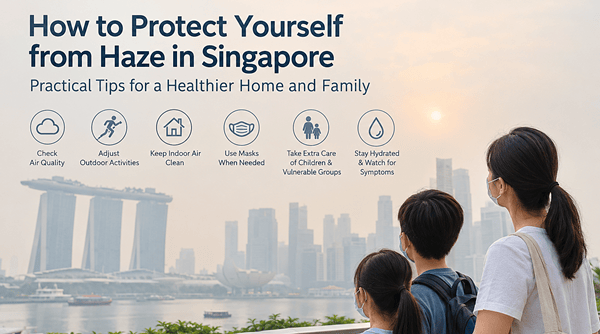
When haze affects Singapore, knowing how to monitor air quality and reduce exposure can help protect your health. Here is what you need to know, from understanding PSI readings to keeping indoor air cleaner.
Singapore experiences haze from time to time, usually caused by forest fires in the region. Dry weather, changes in wind direction and low rainfall can worsen the situation. When haze occurs, the sky may appear hazy, visibility may decrease, and some people may experience irritation of the eyes, nose and throat.
Although haze conditions vary, it is important not to rely on appearance alone when deciding whether to exercise outdoors, bring children to the playground or spend extended periods outside.
The good news is that several practical measures can help reduce exposure to haze and protect the well-being of you and your family.
1. Check Singapore’s Air Quality Before Heading Outdoors
One of the most important steps during a haze episode is to check official air quality information regularly.
Singapore uses the Pollutant Standards Index (PSI) to indicate the severity of air pollution. A 24-hour PSI reading of 101 and above is classified as unhealthy.
The PSI categories are:
- Good: 0–50
- Moderate: 51–100
- Unhealthy: 101–200
- Very Unhealthy: 201–300
- Hazardous: Above 300
For immediate outdoor activities, pay attention to the one-hour PM2.5 concentration readings as well. PM2.5 refers to fine particulate matter measuring 2.5 micrometres or smaller. These particles are small enough to penetrate deep into the respiratory system.
The two indicators serve different purposes:
- 24-hour PSI forecast: Helps you plan activities ahead.
- One-hour PM2.5 readings: Helps you assess recent air quality when deciding whether to undertake outdoor activities.
The National Environment Agency (NEA) advises the public to use the one-hour PM2.5 readings when planning immediate outdoor activities and to check the latest readings before heading out.
You can check official updates through the following channels:
- National Environment Agency (NEA): www.nea.gov.sg
- Singapore haze information portal: www.haze.gov.sg
- myENV mobile application
Making air quality checks part of your routine during periods of concern can help you make better-informed decisions.
2. Adjust Outdoor Exercise When Air Quality Deteriorates
Exercise is important for overall health, but prolonged or strenuous outdoor physical activity during haze episodes can increase exposure to air pollutants.
When air quality deteriorates, consider adjusting your outdoor exercise plans. Depending on the official advisory and your health status, you may need to reduce the duration or intensity of outdoor exercise, move your workout indoors or avoid outdoor activities altogether.
Singapore’s Ministry of Health (MOH) provides different recommendations according to the 24-hour PSI and the individual’s health status. For example, when the PSI is unhealthy, healthy individuals should reduce prolonged or strenuous outdoor physical exertion. Older adults, pregnant women, children and people with chronic heart or lung conditions are advised to take additional precautions.
Children should also adjust outdoor play and exercise when conditions warrant it. Parents, caregivers and schools should follow the relevant health advisories when planning sports, physical education lessons and outdoor excursions.
The appropriate precautions depend on the severity of the haze, the duration and intensity of the activity, and the individual’s health. Follow the latest official advice rather than assuming that every haze episode requires the same restrictions.
3. Keep Indoor Air as Clean as Possible
Staying indoors can help reduce exposure to outdoor haze, but it does not guarantee that indoor air is completely free of pollutants. Fine particles may enter buildings through openings, gaps and ventilation systems.
Consider the following measures when outdoor air quality deteriorates.
Keep windows and doors closed when appropriate.
When outdoor pollution levels are high, closing windows and doors can help reduce the entry of polluted air. Ventilate your home when outdoor conditions improve and it is appropriate to do so.
Use an air purifier if available.
An air purifier equipped with an effective particle filter, such as a suitable HEPA filter, can help reduce airborne particles in an enclosed room. Choose a model appropriate for the room size and follow the manufacturer’s instructions for filter maintenance and replacement.
Maintain your air-conditioning system.
Clean or replace filters according to the manufacturer’s recommendations. Air-conditioning systems differ in their ability to filter fine particles, so do not assume that every system provides the same level of protection.
Reduce indoor sources of smoke and particles.
During haze episodes, minimise unnecessary sources of indoor pollution, including cigarette smoke, incense and activities that generate substantial amounts of airborne particles.
These measures can help reduce indoor particle levels, although their effectiveness depends on the equipment, building conditions and how the measures are used.
4. Do You Need to Wear an N95 Mask?
Not everyone needs to wear an N95 mask whenever haze is present.
According to MOH, healthy individuals generally do not need N95 masks during short-term exposure to haze, such as commuting between home and school or work. N95 masks are also generally unnecessary in indoor environments.
However, MOH advises that healthy individuals who must remain outdoors for several hours when the air quality is in the hazardous range, with a PSI above 300, may reduce their exposure by wearing a well-fitting N95 mask. Older adults, pregnant women and people with severe heart or lung conditions should consult their doctors about whether an N95 mask is appropriate if they must remain outdoors for several hours.
A proper fit is important because gaps around the face can reduce a mask’s effectiveness. Ordinary surgical masks are not designed to filter fine haze particles as effectively as a properly fitted N95 respirator.
An N95 mask is not a substitute for reducing exposure. When official advice recommends limiting or avoiding outdoor activities, follow that advice rather than relying on a mask alone.
5. Take Extra Care of Children and Vulnerable Individuals
Haze can affect people differently. Children, older adults, pregnant women and people with chronic heart or lung conditions may need additional precautions.
MOH’s health advisory recommends different levels of outdoor activity for these groups according to the PSI. For example, when the PSI reaches the unhealthy range, children and other vulnerable individuals should minimise prolonged or strenuous outdoor physical exertion. At higher PSI levels, the advice becomes more restrictive.
Parents and caregivers can help by:
- Checking official air quality updates before arranging outdoor activities.
- Moving outdoor games and exercise indoors when conditions warrant it.
- Ensuring children drink sufficient water.
- Watching for symptoms such as coughing, throat irritation, wheezing or breathing discomfort.
- Following medical advice for children or family members with asthma or other chronic conditions.
People with existing heart or lung conditions should ensure their prescribed medication is readily available and use it according to their healthcare professional’s instructions.
If someone is unwell, especially a child or an older adult, or has a chronic heart or lung condition, seek medical advice when appropriate.
6. Stay Hydrated and Pay Attention to Symptoms
Drinking sufficient water helps maintain hydration and may ease throat discomfort associated with haze. However, water does not remove inhaled pollutants or prevent all health effects.
Short-term haze exposure can cause irritation of the eyes, nose and throat. People with existing heart or lung conditions may experience worsening symptoms.
If you experience discomfort, reduce further exposure by moving to a cleaner indoor environment and limiting physical exertion.
Seek medical advice if symptoms persist, worsen or cause concern. Anyone experiencing severe breathing difficulty or other emergency symptoms should seek urgent medical attention.
7. Make a Simple Haze Preparedness Plan
Preparing in advance can make it easier to respond when air quality deteriorates.
A simple household checklist includes:
- Save official resources: Bookmark the NEA website and haze information portal, and install the myENV app if useful.
- Check your air purifier: If you have one, ensure it is working properly and that its filters are maintained according to the manufacturer’s instructions.
- Review outdoor plans: Be ready to adjust exercise, sports and family activities in line with official advice.
- Keep prescribed medication accessible: Follow your healthcare professional’s recommendations, particularly if anyone in the household has a chronic condition.
- Know when to seek medical help: Pay attention to symptoms and seek professional advice if they persist or worsen.
A little preparation can help households make informed decisions instead of relying solely on whether the sky looks hazy.
Stay Informed, Stay Prepared
Haze is an environmental issue that can affect daily life in Singapore, but sensible precautions can help reduce exposure.
Monitoring official air quality readings, adjusting outdoor activities according to the latest health advisories, keeping indoor air cleaner and paying attention to symptoms are practical steps individuals and families can take.
Rather than waiting until haze becomes visibly dense, make checking air quality part of your routine whenever regional conditions raise concerns.
Useful Official Resources
- National Environment Agency (NEA): www.nea.gov.sg
- Singapore haze information portal: www.haze.gov.sg
- Ministry of Health (MOH) — Haze health advice: Read the official advisory
- NEA — Air pollution FAQs: Read the guidance
Disclaimer: This article is for general information only and does not replace professional medical advice. Follow the latest official advisories and consult a healthcare professional about individual health concerns.
******
新加坡雾霾防护指南:如何保护自己与家人的健康
当新加坡受到雾霾影响时,了解如何监测空气质量及减少污染物暴露,有助于保护自己和家人的健康。本文将带你了解实用的防护方法,包括如何查看空气质量指数、保持室内空气清洁,以及如何安排户外活动。
新加坡不时会受到雾霾影响,尤其是在区域内出现森林和植被火灾、天气干燥,以及风向变化等情况下。雾霾可能导致天空变得灰蒙蒙、能见度下降,也可能引起眼睛、鼻子和喉咙不适。
雾霾的严重程度会随时间和地区而变化。因此,在决定是否到户外运动、带孩子去游乐场,或长时间进行户外活动时,不应只凭天空看起来是否朦胧来判断空气质量。
好消息是,通过采取一些实际且合理的防护措施,我们可以减少接触雾霾污染物的机会,更好地照顾自己与家人的健康。
1. 外出前查看新加坡的空气质量
雾霾期间,最重要的措施之一就是定期查看官方空气质量信息。
新加坡使用**污染物标准指数(Pollutant Standards Index,简称 PSI)**来反映空气污染程度。24小时 PSI 达到101或以上,即属于不健康水平。
PSI 的各个等级如下:
- 良好(Good): 0–50
- 中等(Moderate): 51–100
- 不健康(Unhealthy): 101–200
- 非常不健康(Very Unhealthy): 201–300
- 危险(Hazardous): 高于300
除了 PSI,安排近期户外活动时,也应留意一小时 PM2.5 浓度。
PM2.5 是指直径不超过2.5微米的细颗粒物。这类颗粒物能够深入呼吸系统,因此在雾霾期间尤其值得关注。
这两项指标的用途有所不同:24小时 PSI 预测可帮助公众规划接下来一天的活动;一小时 PM2.5 数据则有助于了解近期的细颗粒物浓度,并根据最新健康建议调整户外活动。
你可以通过以下官方渠道查询空气质量:
- 新加坡国家环境局(NEA):https://www.nea.gov.sg/
- 新加坡雾霾资讯网站:https://www.haze.gov.sg/
- myENV 手机应用程序
养成查看官方资讯的习惯,有助于你在雾霾期间作出更明智的决定。
2. 空气质量恶化时,适当调整户外运动
运动对整体健康十分重要,但在雾霾期间,长时间或高强度的户外活动会增加吸入空气污染物的机会。
当空气质量达到不健康水平时,可以考虑将户外跑步、骑自行车及高强度训练改为室内活动。
不过,并非所有雾霾情况都意味着必须完全停止户外活动。应根据24小时 PSI、一小时 PM2.5 数据、官方健康建议,以及个人的健康状况和活动强度,决定是否需要缩短户外活动时间、降低运动强度或暂时避免户外运动。
儿童在雾霾期间也需要适当调整户外玩耍和运动安排。家长、照护者及学校应根据相关健康建议,合理安排体育课、运动训练和户外活动。
老年人、孕妇、儿童,以及患有慢性心脏或肺部疾病的人士,应特别留意官方建议,并采取适当的防护措施。
3. 尽量保持室内空气清洁
留在室内可以减少接触室外雾霾的机会,但并不代表室内空气完全不受污染。细颗粒物可能通过门窗缝隙、建筑物开口或空调系统的新风入口进入室内。
当室外空气质量不佳时,可以考虑采取以下措施。
适当关闭门窗。
当室外污染程度较高时,关闭门窗有助于减少室外污染物进入室内。当室外空气质量改善后,可视情况适当开窗通风。
在适当情况下使用空气净化器。
配备有效颗粒过滤系统的空气净化器,例如采用合适 HEPA 过滤器的机型,有助于减少封闭空间中的悬浮颗粒物。选购时,应考虑房间面积、设备的净化能力,并按照制造商的说明定期维护过滤器。
妥善维护空调系统。
应按照制造商的建议清洁或更换空调过滤网。不同空调系统过滤细颗粒物的能力并不相同,因此不能假设所有空调都能提供同等程度的保护。
尽量减少室内烟雾和颗粒物来源。
雾霾期间,应尽量避免吸烟、焚香,以及其他会产生大量烟雾或悬浮颗粒物的活动。
这些措施有助于改善室内环境,并减少接触空气污染物的机会。不过,实际效果仍取决于室内外环境、设备性能及使用方式。
4. 雾霾期间是否需要佩戴 N95 口罩?
雾霾出现时,并不是每个人都必须佩戴 N95 口罩。
根据新加坡卫生部(MOH)的健康建议,健康人士在短时间接触雾霾时,例如往返学校、工作地点或其他场所的通勤过程中,一般不需要佩戴 N95 口罩。在室内环境中,通常也不需要佩戴 N95 口罩。
不过,当空气质量达到危险水平,即24小时 PSI 高于300时,如果健康人士因实际需要必须在户外停留数小时,佩戴贴合良好的 N95 口罩可能有助于减少细颗粒物的吸入。
口罩必须与脸部贴合良好,尽量减少边缘的缝隙,否则防护效果可能会降低。
普通外科口罩并非专为有效过滤雾霾中的细颗粒物而设计,因此不能将其视为与贴合良好的 N95 口罩具有相同的防护能力。
N95 口罩也可能让部分人士感到呼吸不适。老年人、孕妇,以及患有心脏或肺部疾病的人士,如果不确定是否适合佩戴 N95 口罩,应咨询医生,并遵循相关健康建议。
最重要的是:当官方建议减少或避免户外活动时,应优先采取相应措施,而不是单纯依赖口罩。
5. 特别照顾儿童及其他较易受影响的人士
不同人士对雾霾的反应可能有所不同。儿童、老年人、孕妇,以及患有慢性呼吸系统或心血管疾病的人士,可能需要采取额外的防护措施。
家长和照护者可以采取以下做法:
- 安排户外活动前,查看官方空气质量数据及健康建议。
- 根据空气质量情况,将户外游戏和运动改为室内活动。
- 确保孩子摄取足够的水分。
- 留意咳嗽、喉咙不适、喘鸣或呼吸不适等症状。
- 对于患有哮喘或其他慢性疾病的孩子,遵循医生提供的日常护理和用药建议。
如果家中有人患有慢性心脏或肺部疾病,应确保其按医嘱使用的药物可以及时取用,并遵循医疗专业人员的建议。
不要假设每个人都能承受相同程度的雾霾暴露。如果不确定应采取哪些措施,建议参考官方健康建议,或咨询医疗专业人员。
6. 保持充足水分,并留意身体症状
保持充足的水分有助于维持身体正常运作,也可能缓解与雾霾有关的喉咙干燥或不适。
不过,喝水并不能清除已经吸入的污染物,也不能预防雾霾可能造成的所有健康影响。
短期接触雾霾可能引起眼睛、鼻子、喉咙或皮肤刺激。对于原本患有心脏或肺部疾病的人士,空气污染也可能使原有症状加重。
如果感到不适,应减少进一步接触污染物,尽可能前往空气较清洁的室内环境,并避免过度体力活动。
如果症状持续、加重,或令你感到担忧,应寻求医疗建议。如出现严重呼吸困难或其他紧急症状,应立即寻求紧急医疗协助。
7. 提前做好家庭雾霾防护准备
提前做好准备,可以帮助家庭在空气质量恶化时更从容地应对。
以下是一份简单的家庭防护清单:
- 收藏官方资讯渠道: 收藏新加坡国家环境局网站和雾霾资讯网站;如有需要,可安装 myENV 应用程序。
- 检查空气净化器: 如果家中有空气净化器,应确保设备正常运作,并按照制造商的建议维护或更换过滤器。
- 提前调整活动安排: 当官方建议减少户外活动时,做好将运动、体育活动和家庭出游改为室内活动的准备。
- 妥善管理日常药物: 如果家庭成员患有慢性疾病,应根据医生建议妥善保管和使用处方药物。
- 了解何时需要就医: 留意需要医疗评估的症状,并在症状持续或加重时及时寻求帮助。
提前做好准备,有助于家庭根据可靠的空气质量数据作出决定,而不是只凭天空是否明显灰蒙蒙来判断风险。
及时掌握资讯,做好雾霾防护
雾霾是一项可能影响新加坡日常生活的环境问题,但采取合理的预防措施,有助于减少污染物暴露。
定期查看官方空气质量数据、适当调整户外活动、尽量保持室内空气清洁,以及留意身体状况,都是个人和家庭可以采取的实用措施。
当区域天气或环境状况引起关注时,不妨养成查看空气质量的习惯,不必等到天空明显变得灰蒙蒙才开始采取防护行动。
官方资讯与实用资源
- 新加坡国家环境局(NEA): https://www.nea.gov.sg/
- 新加坡雾霾资讯网站: https://www.haze.gov.sg/
- 新加坡卫生部(MOH)雾霾健康建议: https://www.moh.gov.sg/others/haze/
- 新加坡国家环境局雾霾管理指南: https://www.nea.gov.sg/our-services/pollution-control/air-pollution/managing-haze
免责声明:本文仅供一般资讯参考,不能取代专业医疗建议。请以新加坡相关政府部门发布的最新公告为准。如有个人健康方面的疑虑,请咨询医疗专业人员。



Leave a Reply