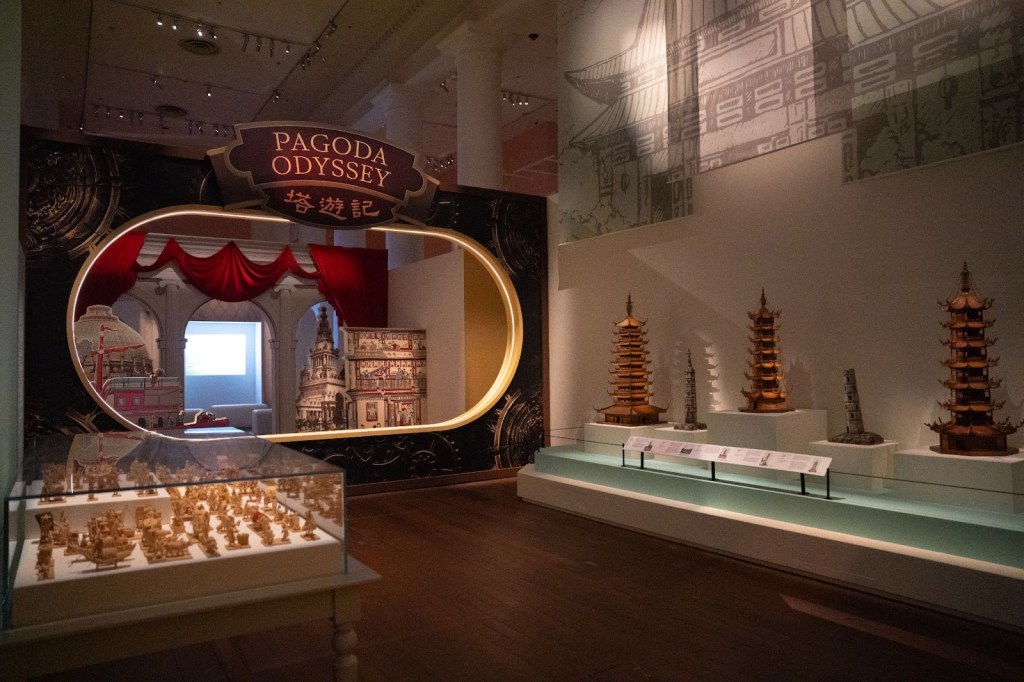
Exhibition view of Pagoda Odyssey 1915: From Shanghai to San Francisco. Image courtesy of Asian Civilisations Museum.
A full set of 84 hand-carved model pagodas will be reunited in public for the first time in over a century at Pagoda Odyssey 1915: From Shanghai to San Francisco, the latest special exhibition by the Asian Civilisations Museum (ACM). Opening to the public this Friday, 31 May 2024, the exhibition traces the extraordinary journey of these models from the Tushanwan Workshop in Shanghai to the Panama-Pacific International Exposition of 1915 in San Francisco.
Pagoda Odyssey unfolds across four main sections in the museum’s Special Exhibitions Gallery, with some objects spread across other galleries and spaces. Together with related works, including 104 figurines that illustrate the coexistence of tradition and modernity that characterised China at the time, the exhibition paints a vivid picture of cosmopolitan Shanghai and San Francisco at the turn of the 20th century, and looks at international expositions as platforms for trade and cultural exchange.
Mr Clement Onn, Principal Curator (Asian Export Art & Peranakan) & Deputy Director (Curatorial & Research) of ACM and the Peranakan Museum explains, “The global odyssey of these handcrafted pagodas weaves a powerful narrative of cultural exchange between East and West that transcends time and space. This exhibition reflects ACM’s efforts to foster connections between Asia and the world, and to celebrate the beauty of Asian artistry and craftsmanship. We are proud to house these remarkable and exquisitely detailed works of art in the ACM collection, and to display them on a grand scale so that visitors can appreciate their craftsmanship and the insights they offer into China’s architectural heritage.”
A glimpse into Chinese architecture
Pagoda Odyssey reflects the enduring legacy of fine craftsmanship in China. Crafted from teakwood, the models were based on real pagodas in China, some of which have since been significantly modified, extensively restored, or otherwise no longer exist today.
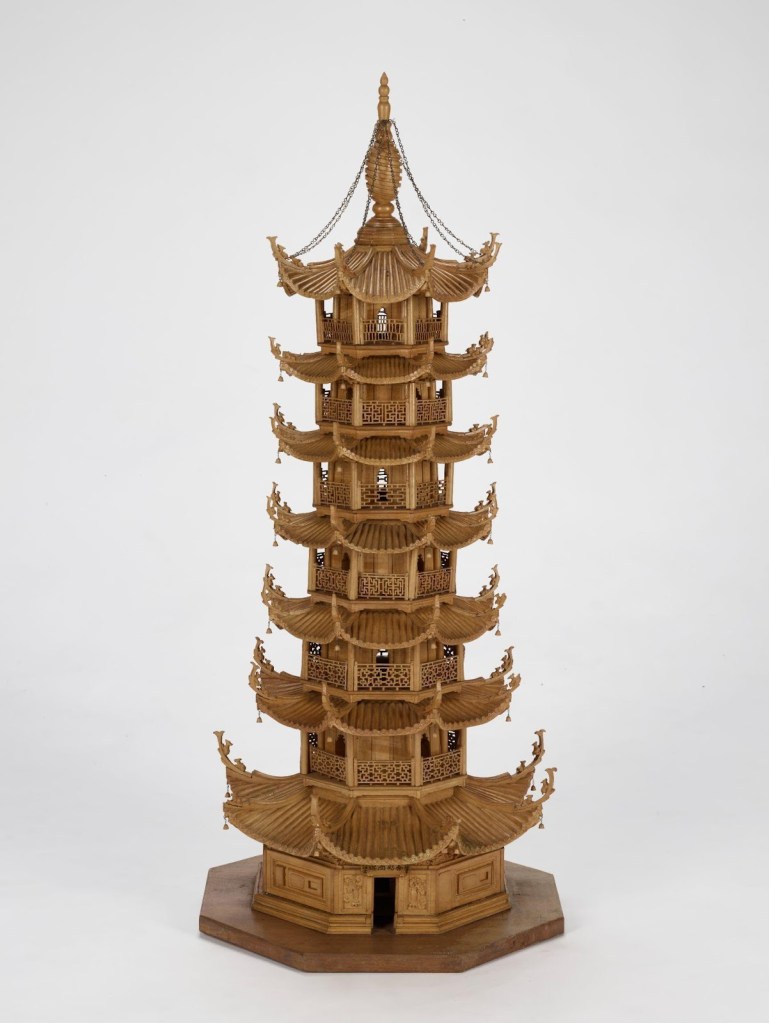
Dragon Flower Pagoda
龙华塔
The Dragon Flower Pagoda, Shanghai’s oldest surviving pagoda, is an iconic symbol of the city captured in countless photographs and postcards. The octagonal base and pronounced flying eaves are characteristic of pagodas from the Song dynasty. Situated near the Tushanwan Workshop, where the collection of pagodas was made, the model has preserved meticulous details from the pagoda as it stood at the turn of the century, before extensive restoration works in 1953.
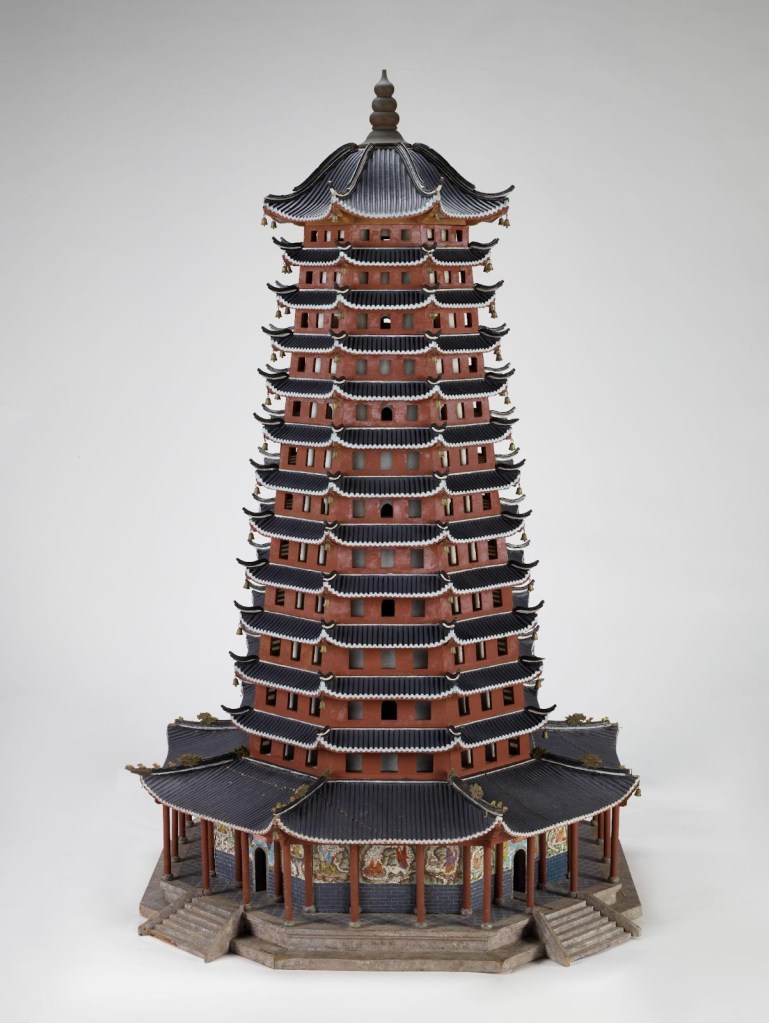
Pagoda of Six Harmonies
六和塔
Within the scenic landscape of Hangzhou, this pagoda was built to quell the fierce tides of the Qiantang River. Originally built with seven floors, restoration works during the Qing dynasty added thirteen eaved-galleries (two per floor), giving it the appearance of a thirteen-story structure. The model blends architectural accuracy with artistic embellishments, capturing the pagoda’s iconic silhouette while introducing a series of wall paintings on the base, which did not exist in the original pagoda.
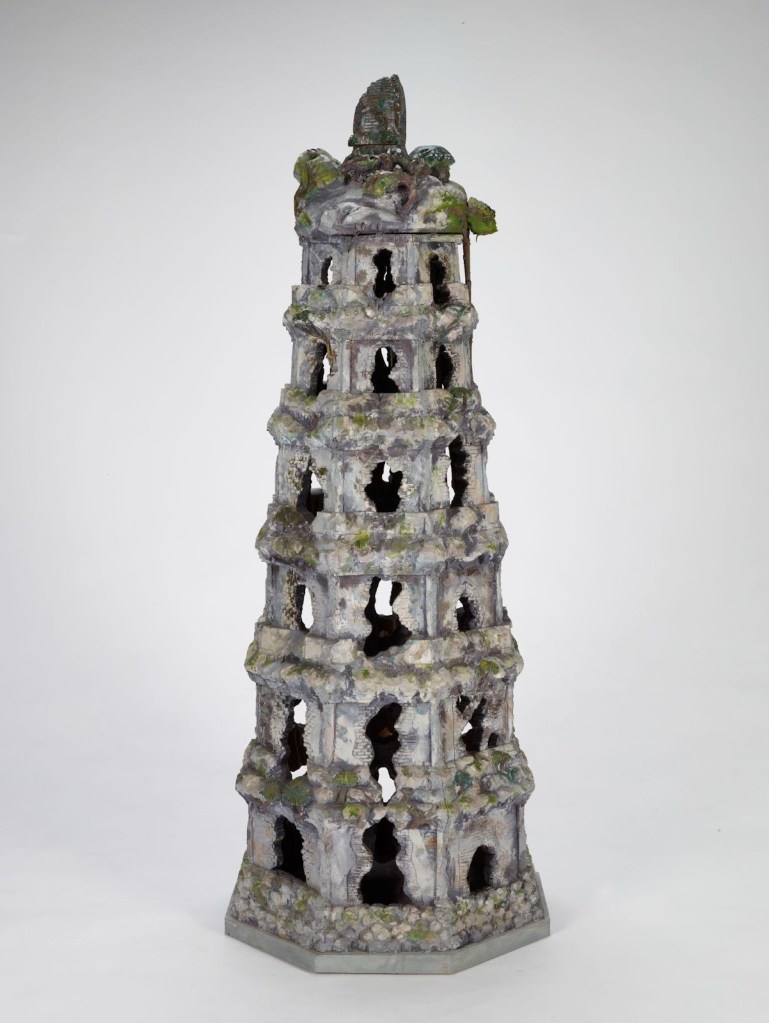
Pagoda of Thunder Peak
雷峰塔
Originally built during the Five Dynasties period near Hangzhou’s serene West Lake, this pagoda was significantly altered following a fire in the Ming dynasty, leaving only its distinctive brick core intact. Its ruined beauty captured the imagination of many, and it was featured prominently in the Legend of the White Snake, a popular romance novel. The model meticulously represents the real pagoda, albeit with an additional level, before it collapsed in 1924.
The models were created at the Tushanwan Workshop, established in Shanghai in 1864 by Jesuit missionaries. Guided by professionally trained priests, young artists were educated in the modern artistic methods of painting, carpentry, sculpture, metalworking, and photography. Many went on to storied careers and influenced other celebrated artists in China. Notable alumni include the watercolourist Xu Yongqing and sculptor Zhang Chongren, while other artists such as Ren Bonian and Xu Beihong were indirectly influenced. The enduring legacy of Tushanwan continues to inspire new generations of artists today.
The meticulously crafted models range from 30 centimetres to over two metres in height, and represent a groundbreaking effort at the time to systematically research, document, and reproduce iconic pagodas from different regions and historical periods. As both a creative endeavour and a research project, the Tushanwan models serve as a vital architectural archive that preserves the essence of these pagodas as they stood at the dawn of the century.
Cultural exchange in Shanghai and San Francisco
The Panama-Pacific International Exposition of 1915 was an important world’s fair that celebrated both the completion of the Panama Canal in August 1914 and San Francisco’s recovery from a major earthquake in 1906. Attracting over 18 million visitors during its 288-day run, the exposition saw 31 countries participating to showcase their cultural and technological advancements. These included the introduction of many pioneering technologies on the world stage, such as demonstrations of the first transcontinental phone call and a fully operational automobile assembly plant.
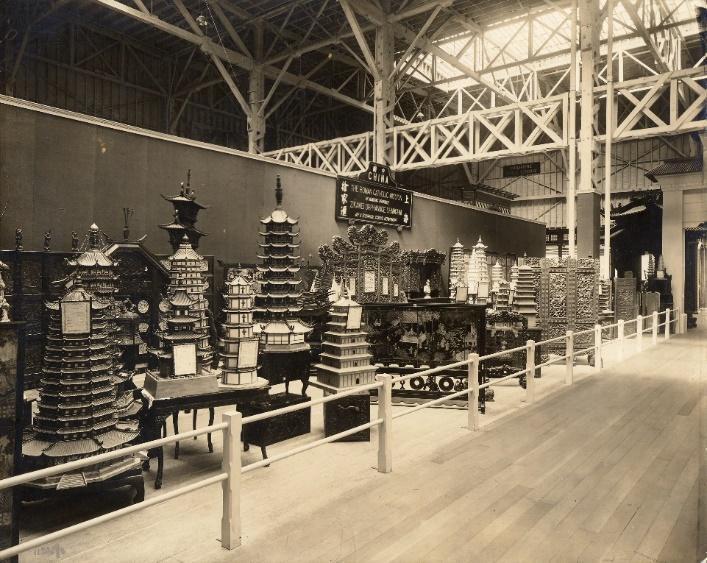
The model pagodas in the Chinese section of the Palace of Education at the Panama-Pacific International Exposition of 1915. Image courtesy of San Francisco History Center, San Francisco Public Library.
China’s participation in the 1915 exposition reflected its commitment to showcase itself as a modern nation on a par with industrialised Western powers. At the exposition, participating nations demonstrated new methods and systems of education at the Palace of Education. These included China’s display of works from different types of schools, such as the full set of 84 model pagodas by the Tushanwan Workshop. To many visitors, the pagodas offered a first glimpse of China’s rich architectural heritage.
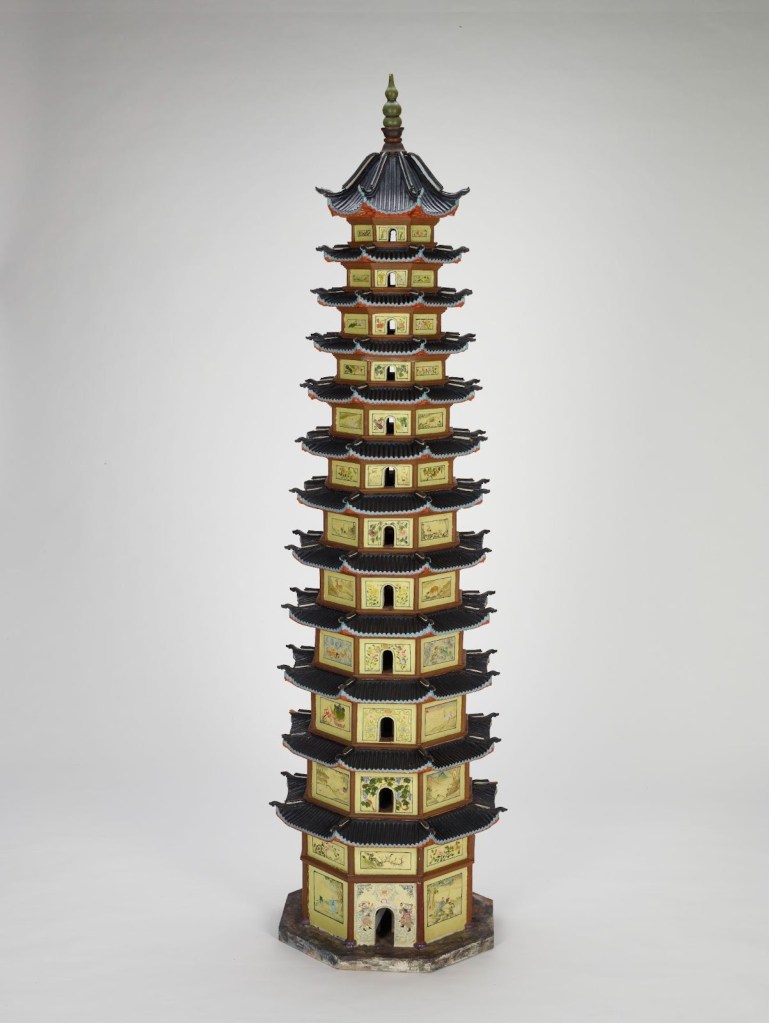
Jingzhou Pagoda
景州塔
Built in the Northern Song dynasty, the Jingzhou Pagoda was a favourite of the Qianlong Emperor. The Tushanwan model goes beyond mere replication, introducing many painted panels not found on the original. These panels depict various narratives and motifs, from scenes featuring the legendary calligrapher Wang Xizhi to floral designs and mythical beings
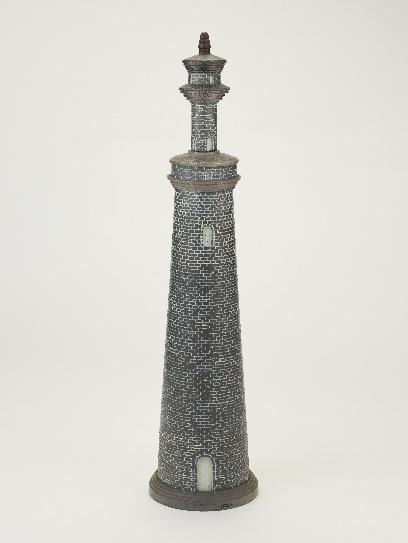
Light Minaret of Huaisheng Mosque
怀圣寺光塔
This minaret was added to Huaisheng Mosque – one of the oldest mosques in China – during renovations to the city in the 11th century. It had a dual purpose, calling Muslims to prayer and guiding ships to port. This model is the only example of an Islamic structure in the set that was sent to the exposition. It is an idealised version: bricks on the exterior are emphasised to suggest resilience, and it restores a calabash-shaped finial that had been destroyed by the early 18th century.
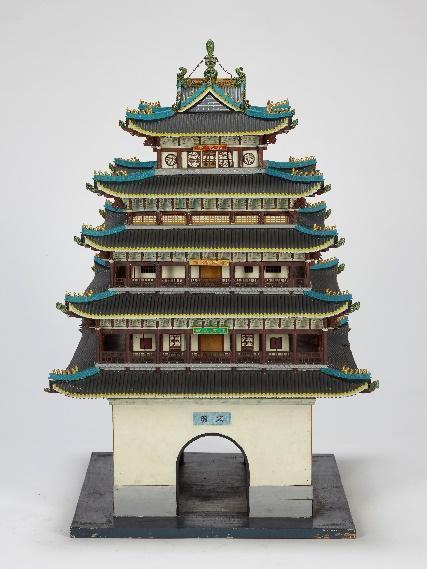
Pavilion of the Brilliant Mountain
光岳楼
One of few towers in the set built without a religious function, this model depicts a defensive watchtower from the early Ming dynasty, which became a cultural icon and tourist attraction in the 17th century. Most of the watchtower’s notable architectural and decorative features were meticulously recreated, including its cross roof and a plaque written by the Kangxi Emperor, who admired its design.
Towers of Faith: A reflection of Singapore’s architectural heritage
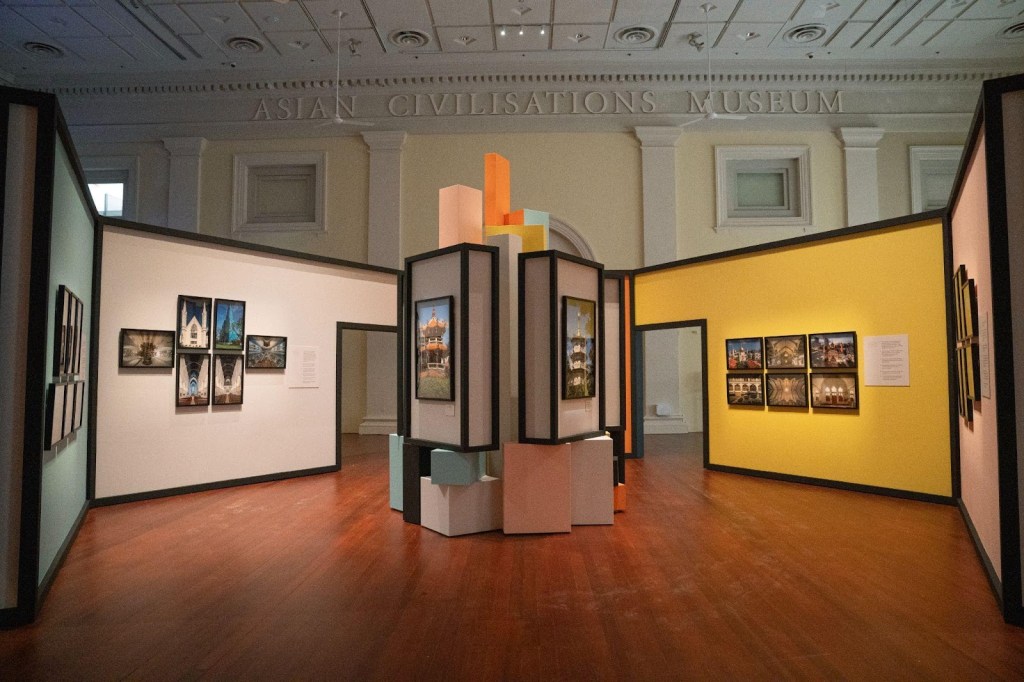
Exhibition view of Towers of Faith. Image courtesy of Asian Civilisations Museum.
Pagoda Odyssey is complemented by Towers of Faith, a photography display that invites visitors to contemplate parallels in the religious architecture of Singapore through photographs and drawings of five local religious organisations and their associated buildings – Lian Shan Shuang Lin Monastery, Yu Huang Gong, Sri Srinivasa Perumal Temple, Sultan Mosque, and Saint Andrew’s Cathedral. In addition to archival materials and visual resources, this display presents a contemporary perspective through a collaboration with award-winning Singaporean architectural photographer Darren Soh. These works create a dialogue between the historical and the contemporary, and illustrate the continuing importance of religious architecture in today’s Singapore.
A feast for the senses through immersive and tactile interactives
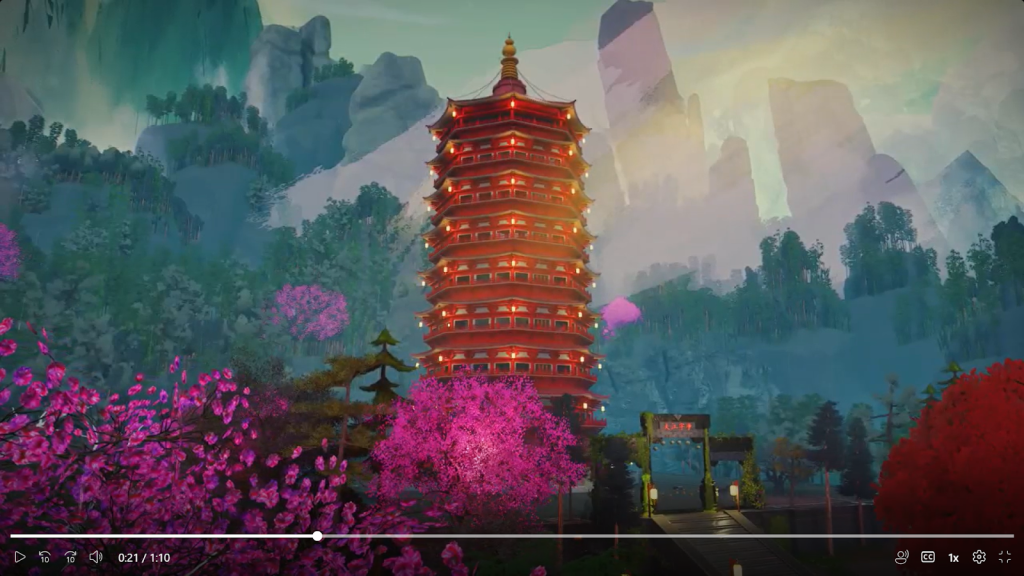
Screenshot from the Journey into the Pagoda virtual reality experience. Image courtesy of Asian Civilisations Museum.
Exploring new approaches to physical and virtual visitor interaction, Journey into the Pagoda is an immersive virtual reality (VR) experience inspired by the architecture and folklore of the Pagoda of Six Harmonies in Hangzhou. Developed in partnership with Microsoft and Cognizant, this VR exploration blends fantasy and reality, bringing to life a pagoda’s architectural form complete with stunning landscapes. The experience takes visitors on a journey through the interior of the pagoda to a mythical creature awaiting at the top.
For the first time at ACM, the exhibition also introduces a hyper-tactile experience, enabling visitors to directly interact with 3D-printed replicas of the model pagodas, as well as replica wooden brackets called dougong, enabling visitors to explore the intricacy of traditional Chinese joinery.
Visitors can also enjoy a range of activities including digital and on-site programmes, talks, symposia and conferences, curator tours, and weekend festivals. Visitors can also visit Pagoda Land to make their own pagodas using LEGO bricks, and participate in other hands-on activities as they conclude their visit to the exhibition. These programmes are held in conjunction with the exhibition and reflect ACM’s dedication to making Pagoda Odyssey a captivating and interactive experience for diverse audiences.
Pagoda Odyssey 1915: From Shanghai to San Francisco runs from 31 May 2024 to 1 June 2025 at ACM. Admission charges apply. For more information, visit www.acm.org.sg.
Follow us @acm_sg | www.facebook.com/asiancivilisationsmuseum
For additional details, please refer to:
- Annex A: About Pagoda Odyssey 1915: From Shanghai to San Francisco
- Annex B: Exhibition Highlights
- Annex C: Towers of Faith
- Annex D: Exhibition Programmes and Activities
 The Insightful Media
Leave a comment